Facades do not soil at a steady rate
When a building owner asks "how often should the facade be cleaned?", the question assumes soiling accumulates at a constant rate and that the answer is a number.
In Riyadh, facades do not soil at a steady rate. They soil in waves. A dust season does in days what quiet months do not, and a spell of rain can leave a facade looking worse than it did beforehand.
So the sharper question is not "how often?" but "after what?".
Four factors that decide it
What actually determines whether a facade needs cleaning:
1 - The building's location
2 - Weather conditions
3 - Rain seasons versus dust-storm seasons
4 - The dust and soiling level at the site itself
There is no fixed schedule by building type, and anyone offering one without seeing your site is selling a number rather than an assessment.
After a dust season
Dust that settles after a storm does not stay loose. With overnight humidity it bonds to the surface and works into the joints between panels, the window frames, and around silicone.
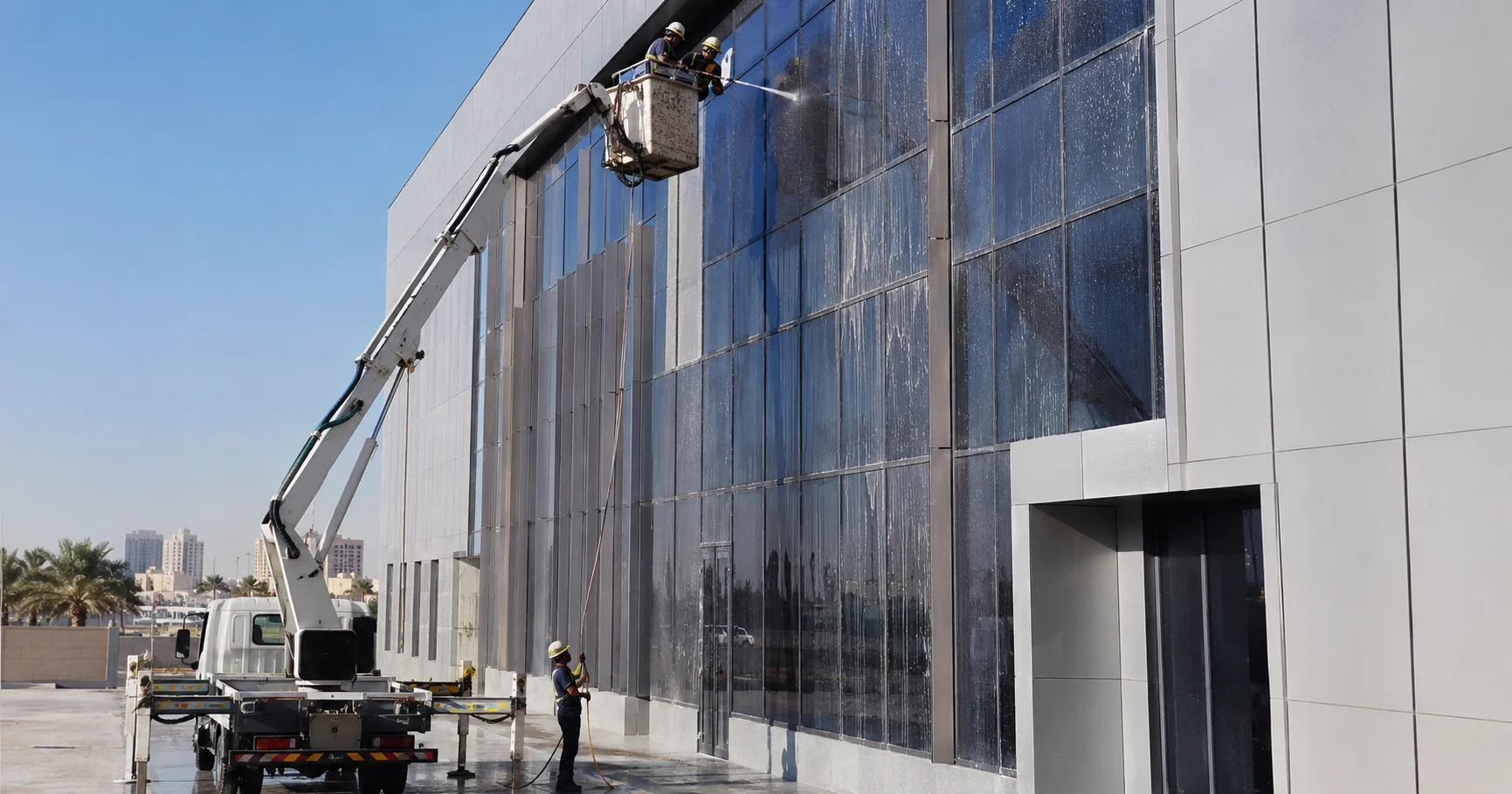
Glass shows it fastest. A thin film is enough to scatter light and reduce clarity from inside before the elevation looks dirty from outside.
Location multiplies the difference. We saw this directly at Al-Mousi Submersible Pumps in Riyadh: dust accumulation on the facade was tied to the building's position on a main road, alongside its height.
After rain: the opposite of what is expected
Many owners assume rain washes a facade. Sometimes it does. Often it does the reverse.
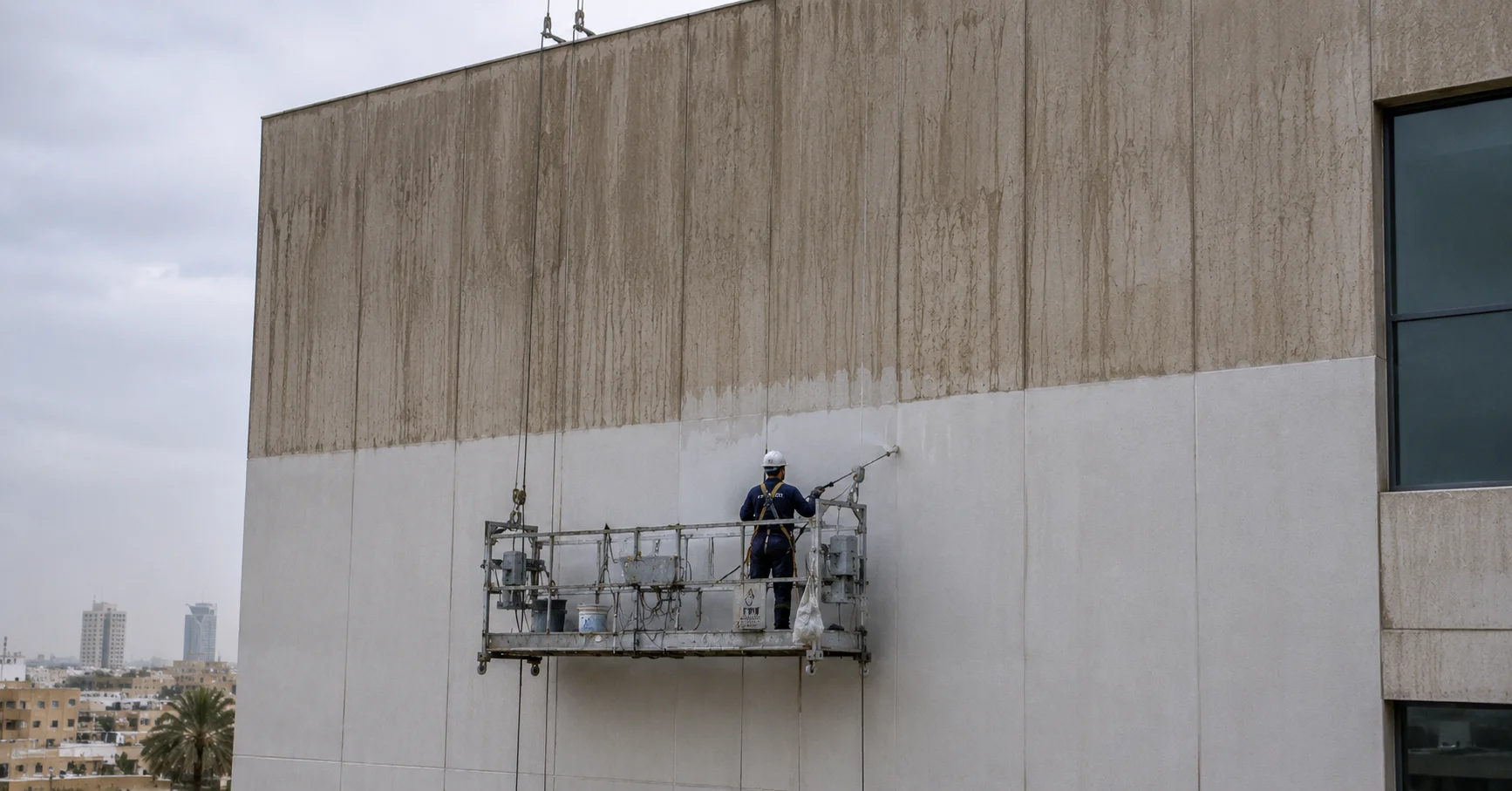
Light rain on a dusty elevation does not remove the dust — it mobilises it and redeposits it in streaks. The result on glass and on pale surfaces looks worse than the even layer of dust that preceded it.
Rain also exposes problems that were hidden: seepage points around frames, water tracking that reappears in one place, or deteriorating joint material.
So the period after rain is not only a cleaning window. It is an observation window. Water tracking that returns to the same point after every rainfall is not soiling. It is a signal.
On stone: salts
Stone and marble elevations respond to moisture in their own way. Moisture draws salts from within the stone to the surface, where they crystallise and leave a white bloom known as efflorescence.
Washing it with water alone dissolves it temporarily and it returns more visibly, because the water adds the very moisture that mobilises the salts. Treating it needs specific materials, not repeated washing.
On cladding: joints before panels
After a dust season, the first thing to show on a cladding elevation is not the panels but the joints between them. Rain partially washes a flat face; a joint keeps what enters it.
Post-season cleaning therefore has to include the joints and silicone, or the dark lines stay visible however clean the panels are.
When should the visit be scheduled?
The practical rule is simple: after the season ends, not during it.
Cleaning mid-season means repeating it a fortnight later. Waiting too long after it ends means whatever bonded has become harder to remove.
This is why many owners prefer to tie visits to seasons rather than to the calendar — which is what recurring contracts allow, on four frequencies: monthly, quarterly, half-yearly or annual. The quarterly frequency in particular falls naturally after seasonal transitions.
What to look at yourself after a season
Four signs that need no expertise:
1 - Streaking on glass, visible when light strikes it from an angle.
2 - Dark lines between cladding panels, more prominent than the panels themselves.
3 - A white bloom on stone that was not there before the rain.
4 - Water tracking returning to the same spot — the most important, because it is not soiling.
What to do between seasons
Not everything that appears after a season calls for an immediate visit. Between seasons there is plenty worth observing without intervening.
Observe rather than treat it yourself. Attempting to remove a mark from a high elevation with household tools usually ends in streaking worse than the original, or a scratch on a surface that cannot be corrected. More seriously, reaching height without proper equipment is a risk the result does not justify.
Photograph what you notice. A dated photograph of water tracking or a recurring stain says more than a description, and shows whether the mark is spreading or stable. That single detail often decides whether it is soiling or something else.
Do not wash stone with water alone. If a white bloom appears on a stone elevation, washing it with water will bring it back more strongly, because it adds the moisture that mobilises the salts.
Does elevation orientation change the effect?
Yes, and the difference is noticeable in practice. The elevation facing the street takes more dust and road spray than the rear of the same building, and a face exposed to the prevailing wind takes more than one sheltered behind a neighbouring structure.
So not every elevation on a building necessarily needs the same frequency. Determining that is a survey question, and it can produce a different scope per face rather than a full building visit every time.
Post-season cleaning and routine maintenance work together
Post-season cleaning responds to an event. Routine maintenance follows a fixed schedule. The two complement each other rather than competing.
Clients on a recurring contract usually find their visits fall close to the seasonal transitions, particularly on the quarterly frequency. Clients booking one-off visits can simply tie the appointment to the end of a season rather than to a fixed month in the calendar.
We assess before proposing a date
If a dust or rain season has passed and you are wondering whether the facade needs a visit, send us a photo taken after the season along with the building's rough location, and we will tell you what we see and whether it warrants a visit now or can wait. Site inspection and quotation are free.