Your frontage works even when you are closed
A retail business pays rent for a location, and a location means being seen. But what passers-by actually see is not the location — it is the frontage: the glass, the sign, and the frame around them.
Your frontage is the one advertisement that runs twenty-four hours and does not stop when you lock up. Customers decide to come in or walk past within seconds, often before they have read your name.
So the question is not whether the frontage gets cleaned. It is when — because cleaning it at the wrong hour costs you the very thing you are paying the location for.
Bad timing costs more than the dirt does
Cleaning a shopfront during trading hours means three things at once: a partly obstructed entrance, equipment in front of the window, and a customer who defers coming in.
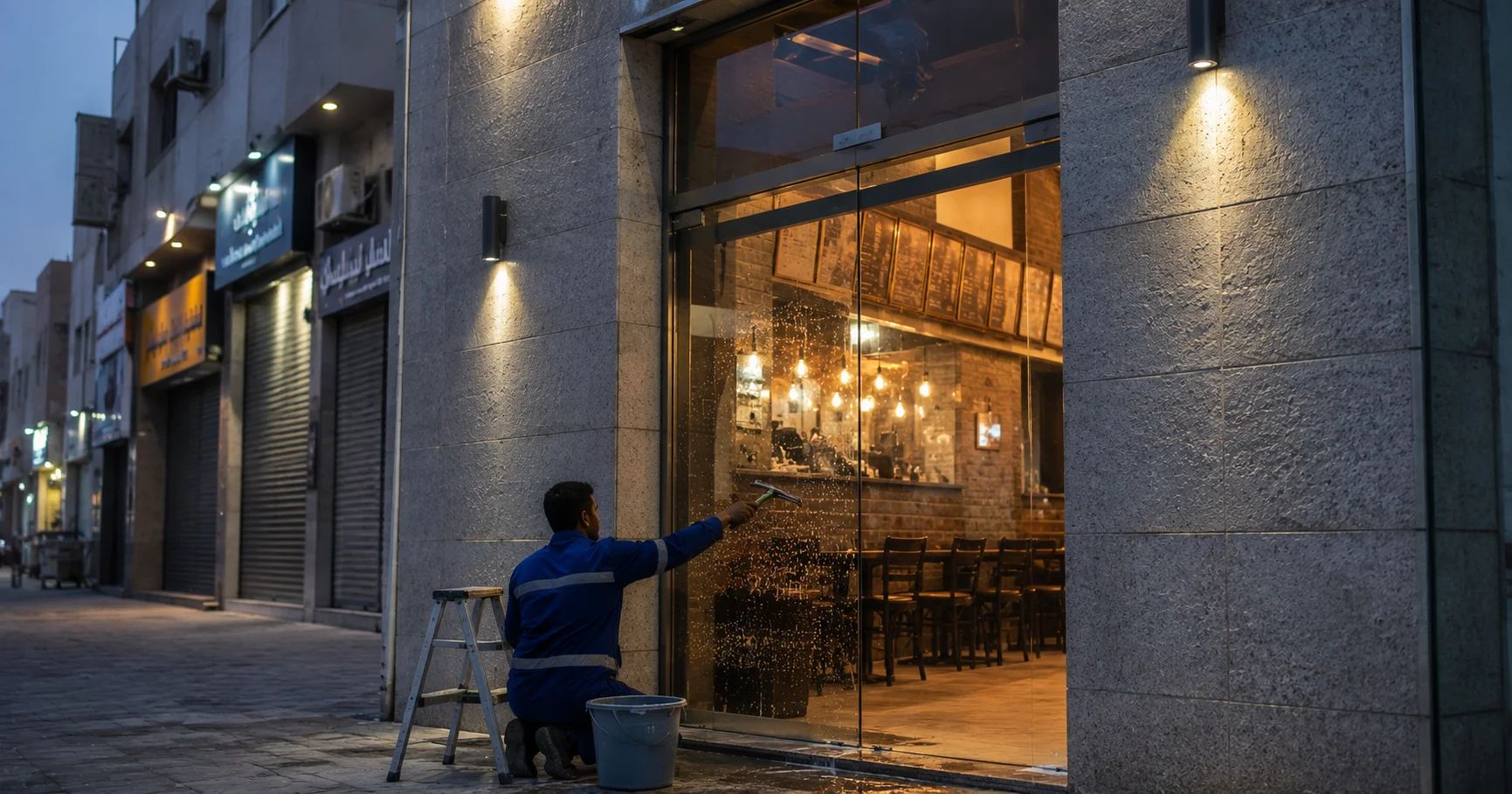
So we work outside trading hours, before opening, or on closed days, on a slot agreed in advance. The aim is that you open onto a clean frontage — not that you close in order to clean it.
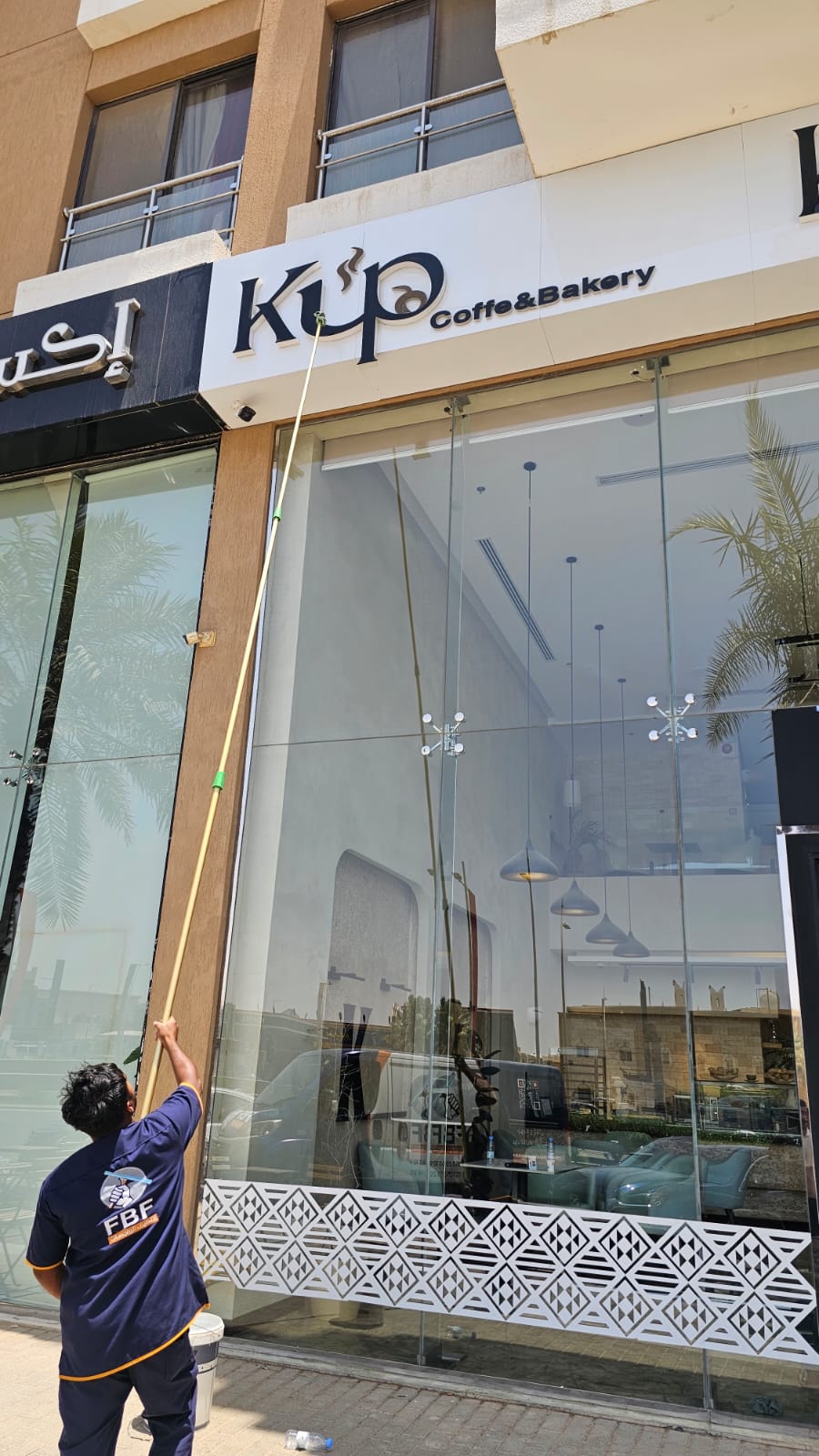
At KUP Coffee & Bakery in Riyadh the stated challenge was exactly this: completing the work before the shop opened and customers arrived. Tools suited to the height of the frontage and sign were used, with materials safe for both the glass and the signage, and the work covered the full glass frontage and the shop sign.
The sign is not an optional extra
The most common mistake in shopfront cleaning is cleaning the glass and leaving the sign.
The sign and the glass are seen together from the street. Cleaning one without the other leaves a frontage that reads as unfinished in a way passers-by notice even if they could not say why. And the sign is the part carrying your name — the part that actually represents you.
We therefore handle glass and signage in the same visit, with materials safe for both surfaces.
Restaurant frontages are a different case
A restaurant frontage is not a clothing shop's. A kitchen operates behind it, and the use around it is heavier: hands on the glass, constant movement at the entrance.
Restaurant frontages can also develop grease deposits that need dedicated treatment before the glass is cleaned. Ordinary glass cleaner lifts the dust and leaves the greasy film, which collects dust again within days — making it look as though the clean never happened.
The space in front of the shop decides the method
Shopfronts carry a constraint standalone buildings do not: the space in front is usually tight, and there are people moving through it.
At Qut Al-Bahr Seafood Restaurant the space in front of the shop was tight, with customer movement at the location. Scaffolding sized to that tight space was used, with the precautions needed to secure the working area, and the work was finished before opening time.
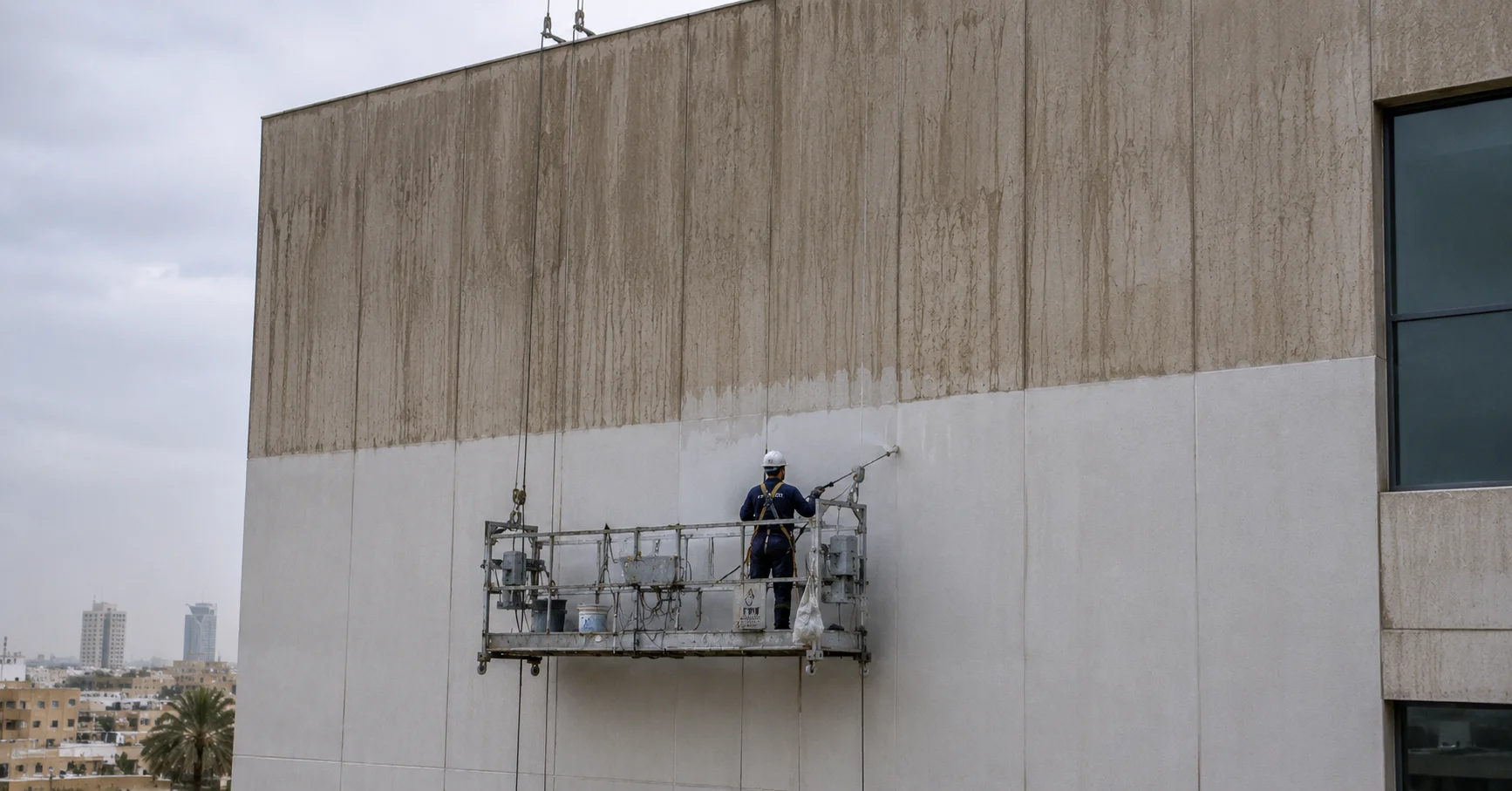
It covered the entire shopfront — cladding, glass and shop signage — with dust and fit-out residue removed.
After a fit-out, the first clean matters most
Many shops open with a frontage that was never cleaned after the fit-out. Adhesive residue on the glass and construction dust on the sign then stay for months, because nobody scheduled a visit for them.
At Mama Noura Luqaimat, the clean followed the completion of the shop's fit-out, on a fixed slot finished quickly ahead of opening, covering the full facade, the restaurant signage, and the glass inside and out.
How often should a shopfront be cleaned?
There is no single interval that fits every shop, and anyone quoting you a number without seeing your location is guessing.
What actually drives the frequency: the shop's location, the weather, the rain and dust-storm seasons, and how much soiling the site itself collects. A unit on a busy main road needs cleaning more often than one in a quiet internal arcade.
For owners who would rather not track it, a recurring cleaning contract on a fixed schedule is available.
The parts of a shopfront that get forgotten
When someone asks for "the frontage cleaned", many contractors hear the glass alone. What a passer-by sees is wider than that, and three parts are usually left out — each of which undoes the result:
The frames around the glass. A dark or dusty frame around clean glass makes the glass itself read as less clean than it is, because the eye compares.
The threshold and door edge. The most-touched point in the whole unit, and the first thing seen on entering.
The lower section of the frontage. It takes splash-back from the ground and road spray, and stays soiled even after everything above it has been cleaned.
Clean, versus looking clean
There is a difference between the two, and it is technical rather than a matter of marketing.
Glass can be entirely free of dust and still carry streaking that appears under side lighting, or in the early morning and evening. The usual causes are the wrong materials, tooling that was not properly cleaned itself, or letting the surface dry without a correct finish.
This is why the final inspection has to happen after the surface dries, not before. Judging glass while it is still wet conceals exactly what your customer will see an hour later.
Is recurring cleaning cheaper than cleaning on demand?
A fair question, and the answer depends on your location rather than on a general rule.
What can be said plainly: the longer the gap between visits, the more each visit has to treat. Recent dust lifts with washing; what has sat for months through humidity and sun needs more time and more treatment.
For owners who would rather avoid that swing entirely, recurring contracts are available on four frequencies — monthly, quarterly, half-yearly or annual — at a price agreed in advance and on a fixed schedule.
We open with you, not instead of you
If you want a clean frontage at opening without losing a single selling hour, send us a photo of it and your trading hours and we will propose the timing. Site inspection and quotation are free.