
The problem is not the cleaning — it is remembering it
Most building owners do not postpone facade cleaning because they do not want it. They postpone it because nobody owns remembering it.
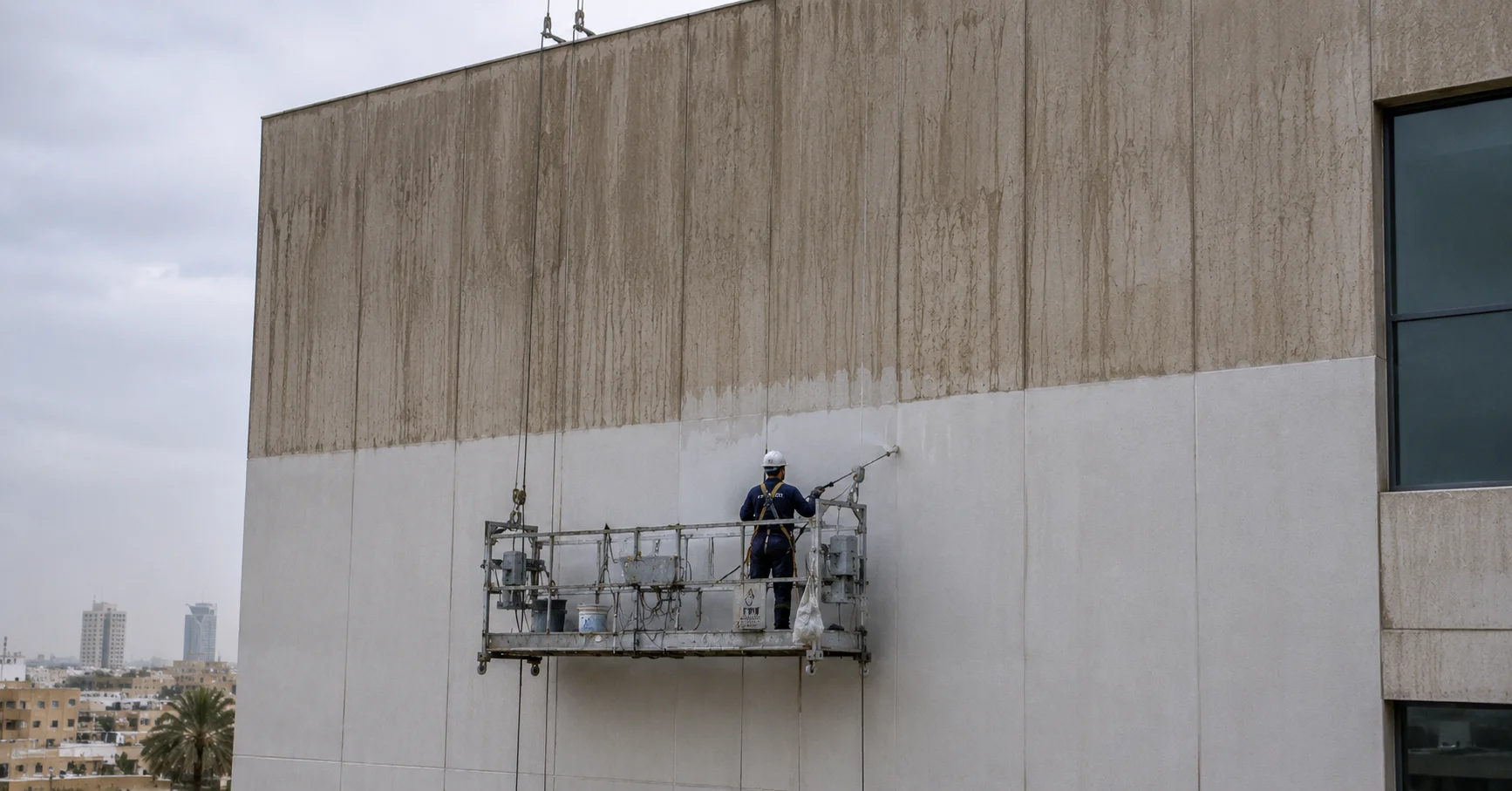
A facade does not fail suddenly like a lift, and it does not raise an alarm like an air-conditioning unit. It soils slowly, day by day, until it reaches a point a visitor or a manager notices — and by then it has looked that way for weeks.
A maintenance contract solves precisely that problem. It moves the remembering off your schedule and onto ours.
Four frequencies
We contract on four frequencies:
- Monthly
- Quarterly
- Half-yearly
- Annual
The right one is not chosen from a menu; it comes from the building. What decides it: the building's location, the weather, the rain and dust-storm seasons, and how much soiling the site itself collects.
A building on a busy main road soils faster than one on a quiet street. A glass elevation shows dust sooner than pale stone does. So we propose a frequency after the survey, not before it.
What the contract actually includes
A price agreed in advance
The price is set when the contract starts and holds for its term. No re-quoting per visit, and no surprises on the invoice.
That matters more than it sounds. Per-visit pricing is one of the reasons cleaning gets deferred in the first place, because it turns every occasion into a fresh decision.
A fixed schedule you do not have to chase
Visits are scheduled in advance. No calling, no reminding, no negotiating a date each time.
Priority scheduling
Contract clients get priority on appointments. That matters most when something falls outside the schedule: after a dust season, ahead of an event, or before an important visit.
A condition note after every visit
After each visit you receive notes on the facade's condition. This is not administrative decoration. The facade is usually the first place a building shows a problem.
Water tracking that keeps reappearing at one point, deteriorating joint material, a change in a cladding surface — these are visible to a crew standing at arm's length from the elevation several times a year, and invisible from the street.
Contract versus one-off visit
Pricing: quoted each time on a one-off visit, agreed in advance on a contract.
Scheduling: requested each time, versus fixed and pre-booked.
Follow-up: yours, versus ours.
Priority: subject to availability, versus priority for contract clients.
Facade condition: known when you ask, versus reported after every visit.
A one-off visit is exactly right for a specific occasion: after a fit-out, before an event, or on acquiring a building. A contract is right when you would rather not think about it at all.
Are contracts only for large companies?
No. Recurring contracts are available across all sectors: shops and restaurants, villas and homes, and corporate offices and headquarters.
A single unit with a glass frontage and a sign can sit on a contract for the same reason a multi-branch corporate client does. The scope and the frequency change; the principle does not.
What to ask before signing
1 - What exactly is in scope? Glass only, or glass, signage and joints?
2 - What happens if you need a visit outside the schedule?
3 - Will you receive condition notes, or only confirmation that a visit happened?
4 - Who sets the frequency, and on what basis? If the answer mentions neither the building's location nor the weather, the frequency came from a menu rather than from your building.
How the right frequency is chosen
Frequency is not a preference. It falls out of four factors:
The building's location. A building on a busy main road takes far more dust and road spray than one on a quiet internal street. That factor alone can move a building from half-yearly to quarterly.
Weather conditions. Humidity fixes dust onto the surface rather than leaving it loose, making it harder to remove later.
Rain seasons versus dust-storm seasons. Each leaves a different mark. Dust accumulates; rain can mobilise what has accumulated and redeposit it in streaks.
The soiling level at the site itself. A location beside active construction is not a location that has been settled for years.
We add a fifth, practical factor: surface type. Glass and pale finishes show the effect sooner than dark ones, even when the amount of dust is identical.
Can the frequency change during the contract?
Yes — and this is one reason the post-visit condition notes matter.
If the notes show the facade reaching the next visit still in good condition, the frequency is heavier than it needs to be and can be eased. If it arrives visibly soiled, the frequency is not enough.
The correct frequency emerges after a cycle or two of actual observation, not from a first estimate. Anyone insisting on a fixed frequency without reviewing it is selling a schedule rather than a service.
What the contract does not cover
Being explicit here prevents misunderstanding later. A recurring cleaning contract is a cleaning contract. Where we observe something beyond cleaning during a visit — deteriorating joint material, or water tracking that keeps returning to one point — it is reported in the visit notes.
Reporting the condition is part of the contract. Remedial work beyond cleaning is assessed separately.
We start with a survey, not a quote
We will not propose a frequency before seeing the building. Send us a photo of the facade, the approximate height, and the location, and we will propose a frequency with the reasoning behind it, then the price. Site inspection and quotation are free.