A villa is not a small tower
It is easy to assume that cleaning a villa facade is a scaled-down version of cleaning a tower. Less height, therefore less work.
In practice the two are different problems. A villa raises questions a tower does not, and a tower raises questions a villa does not. The difference is not size — it is the kind of constraint.
We carry out villa and home facade cleaning in Riyadh, and this article sets out what genuinely differs.
First: several surfaces on one building
A commercial tower is usually one surface repeated — glass, or cladding, or stone.
A villa facade typically combines several surfaces in a small area: stone or marble on one section, paint on another, glass at the windows, and sometimes cladding on a canopy or entrance. Add metal frames, canopies and railings.
Each surface needs a different material and method. Stone is porous and reacts badly to high pressure and the wrong chemistry. Cladding carries a protective coating that strong materials damage. Glass needs treatment that prevents streaking and spotting. Paint needs the gentlest handling of all.
Using one material across all of them means it is either too weak for some or too harsh for others. There is no third outcome.
Second: access inside a residential street
This is the largest difference, and the one that surprises most owners.
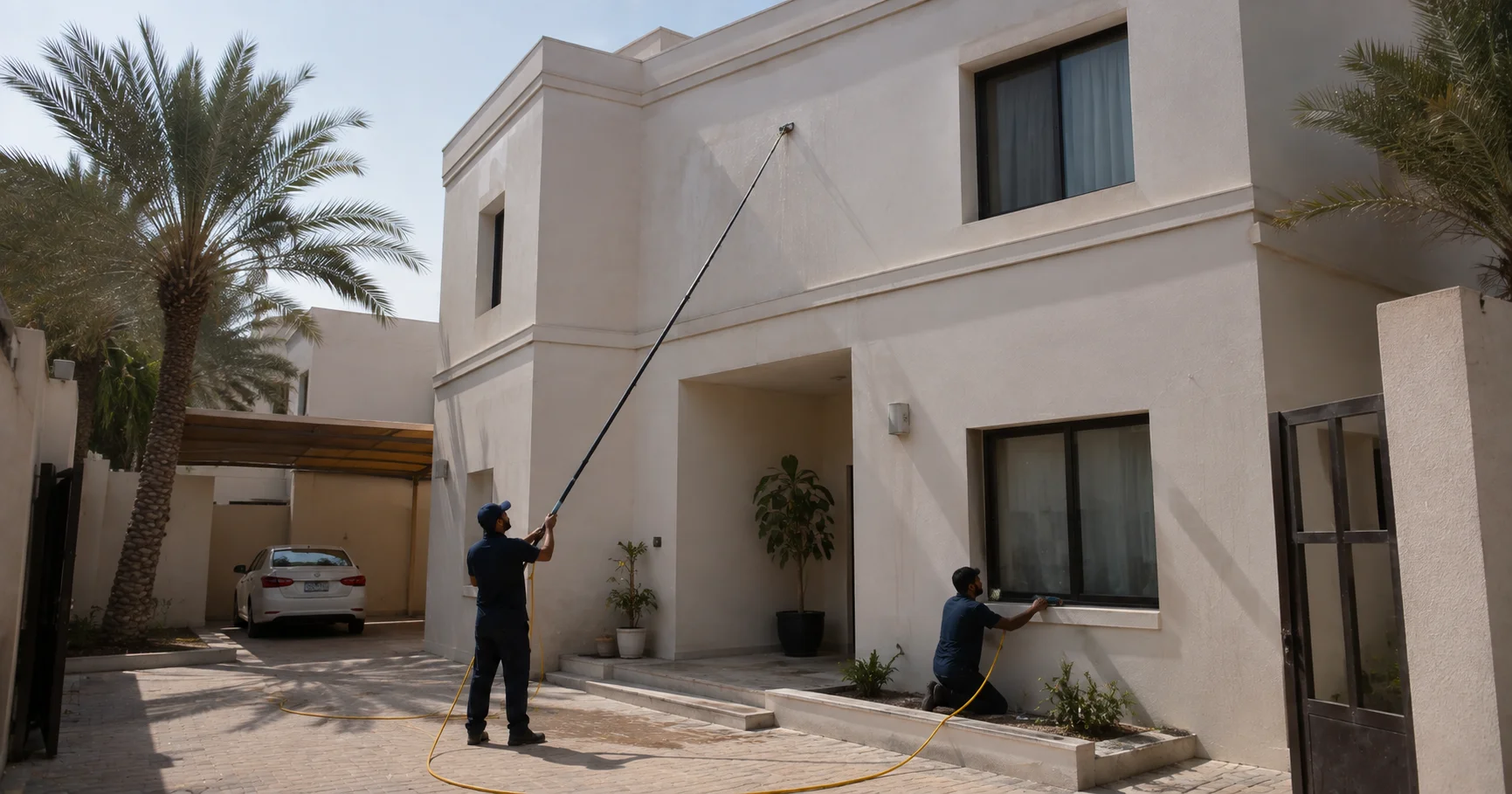
A commercial tower usually has a reasonably open perimeter and parking that can be used. A villa sits on a residential street: limited width, neighbours' cars parked along it, boundary walls, and often a front garden or canopy that keeps equipment away from the elevation.
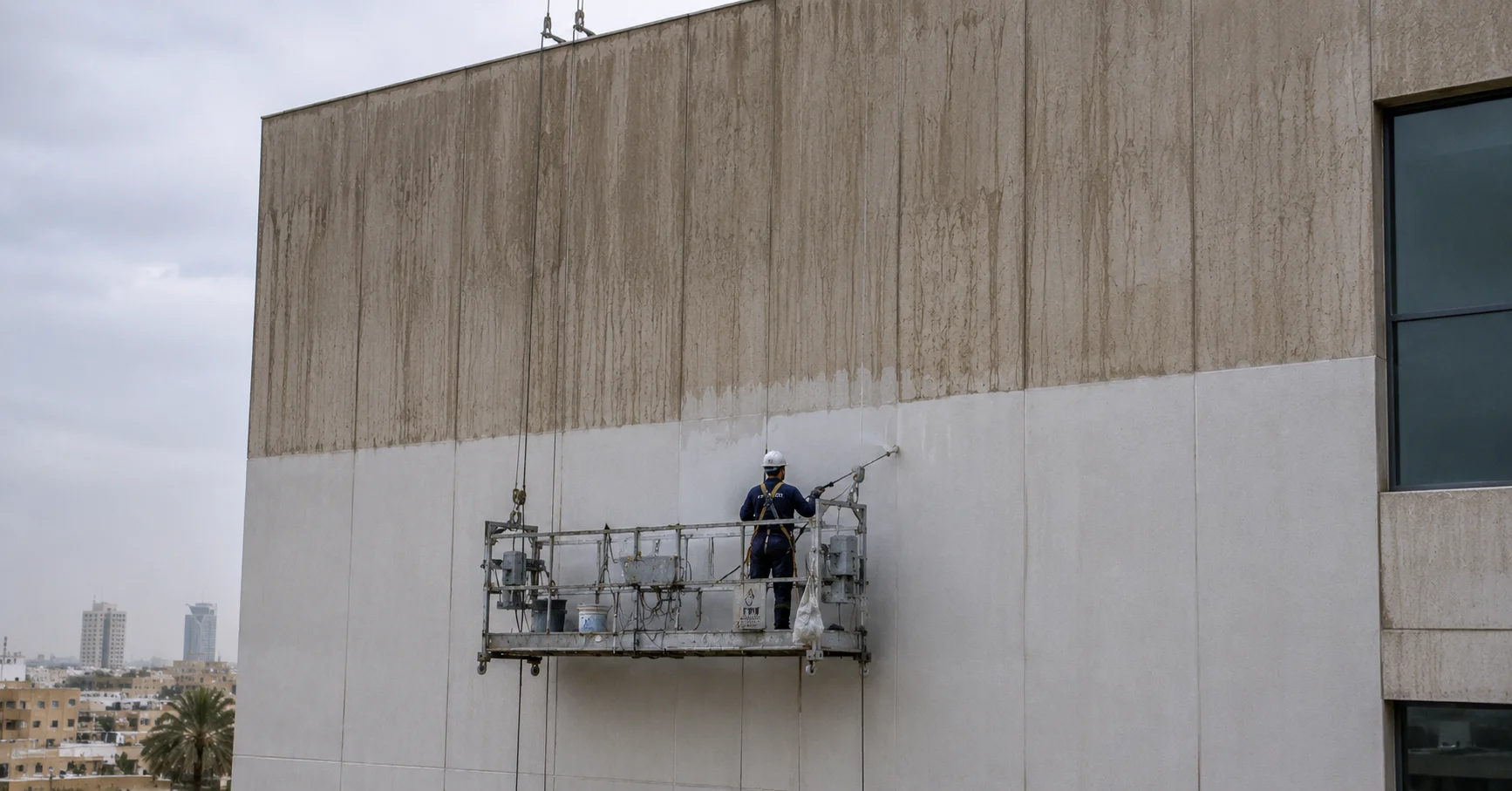
So the access method is decided by the street, not by the facade. Where there is not room for a lift, scaffolding or rope access becomes the answer — exactly as it does on shopfronts with narrow frontages.
There is also a dimension commercial buildings do not have: neighbours. Working in a residential street means attention to noise, timing, and not blocking anyone's access. We work in an organised way that avoids disturbing residents or neighbours, and we secure the garden and entrance during the work.
Third: cleaning after construction, before occupancy
The best timing for a villa's first facade clean is after construction and fit-out finish and before the family moves in.
The practical reason: after construction the facade carries the dust of the works and the residue of the finishing trades — filler marks, paint overspray, protective-film adhesive on the glass, dust in the frames. That residue bonds and becomes harder to remove the longer it stays.
The second reason is that pre-occupancy work is easier on everyone: no furniture in the way, no coordinating around the household's routine, and no anxiety about newly planted landscaping.
Fourth: timing once the house is occupied
After a family moves in, timing becomes a household question rather than an operational one. Appointments need flexibility that fits the home's routine, and we schedule accordingly.
How often should a villa facade be cleaned?
There is no fixed interval, and any number offered without seeing the house is a guess.
What decides it: the home's location, the weather, the rain and dust-storm seasons, and the dust level at the site itself. A villa on a busy main road needs cleaning more often than one on a quiet internal street. A pale elevation shows the effect sooner than a dark one.
For owners who prefer a fixed schedule, recurring contracts are available on four frequencies: monthly, quarterly, half-yearly or annual.
What the work covers
We handle every facade type: glass, stone, cladding and painted surfaces. The work includes windows, frames and canopies — cleaning the glass alone leaves the darker frame around it visible and undoes the effect.
The four surfaces and how each is treated
Stone and marble
A porous material, and that changes everything. Careless high pressure opens the pores so the stone soils faster afterwards than it did before, and it can wash out the pointing between panels.
The most common problem on stone elevations is efflorescence: salts drawn out of the stone by moisture, crystallising on the surface as a white bloom. Washing with water alone dissolves it temporarily and it returns more visibly, because the water adds the very moisture that mobilises it.
Cladding
Carries a protective coating that strong chemicals and abrasion destroy. We use materials that do not attack it, and controlled pressure that does not penetrate the joints between panels.
Glass
Needs dedicated tooling and treatment that prevents streaking and spotting. On villas the glass usually sits within frames, and cleaning the glass without the frame leaves a visibly unfinished result.
Painted elevations
The gentlest handling of the four. Strong materials or high pressure can affect the paint itself, and that is not corrected by cleaning — only by repainting.
Windows, frames and canopies
On villas in particular, what surrounds the glass is as visible as the glass. A dusty frame around a clean window undoes the result, because the eye compares the two directly.
So the work covers windows, frames and canopies rather than the large surfaces alone. Canopies especially collect dust that is invisible at eye level but obvious from an upper floor or from across the street.
A survey first
We identify the surfaces and the access method at survey, after seeing the house and the street in front of it. Send us a photo of the elevation, the approximate number of floors, and a description of the space in front, and we will explain what will be used and why. Site inspection and quotation are free.