The decision that comes before any cleaning
Before work begins on any facade, one decision is made at survey and everything else follows from it: how do we reach the surface?
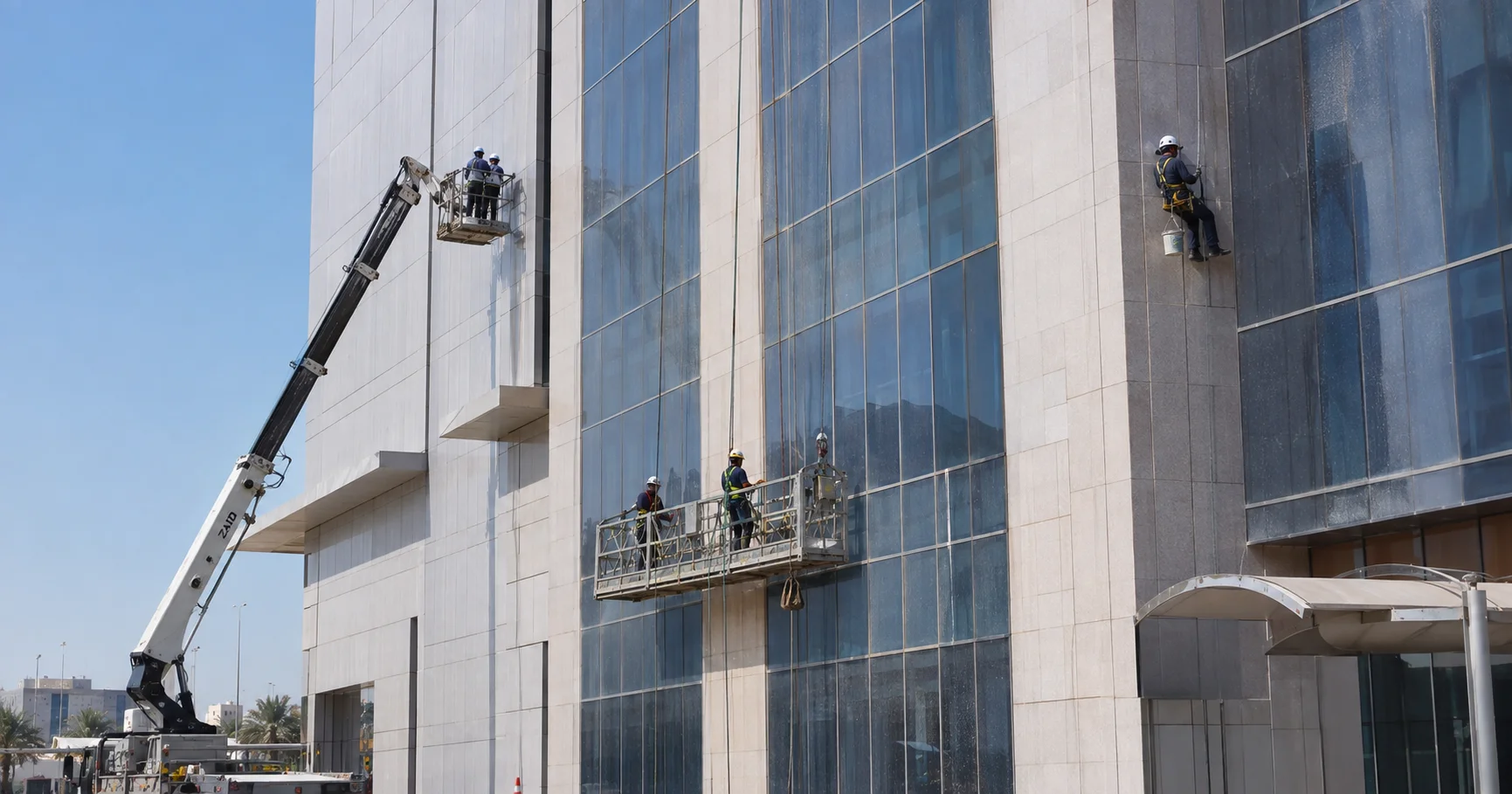
The answer is not a standing company preference. We work with four access methods — rope access, suspended cradles, boom lifts and scaffolding — and choose between them based on the building itself. A contractor who owns only one method will explain why that method suits your building, because it is the only one available to them.
This article sets out what actually drives the choice.
The four factors that decide it
1. Building height
Height is the first thing considered, but rarely the deciding one. We work at any height, from the first floor to the last. What changes with height is which methods remain practical in terms of time and securing the area below.
2. The space available in front of the building
This is the factor most often overlooked, and the one that most often overturns the decision. A vehicle-mounted lift needs room to position and deploy its arms safely. Without that room it is not an option, however well-suited the facade itself might be.
At Qut Al-Bahr in Riyadh the space in front of the shop was tight, so scaffolding sized to that space was used instead of a lift. The decision came from the site, not from the facade.
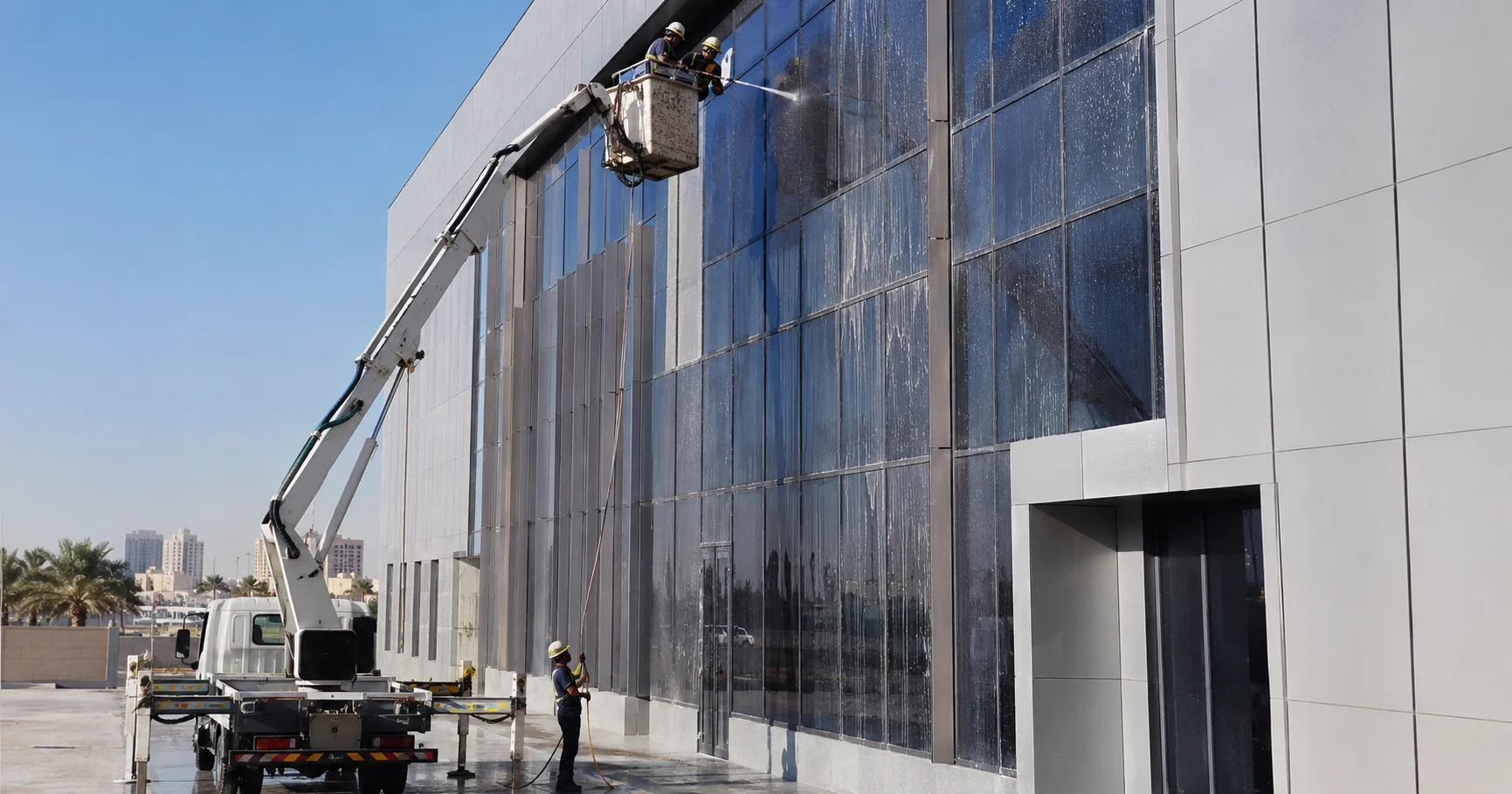
Conversely, at Al-Mousi Submersible Pumps the space allowed it, and a vehicle-mounted lift gave safe access across the building's full facade height.
3. Whether the building is operating
Is the building closed, or trading? Is there footfall directly beneath the work area?
At Qut Al-Bahr the work proceeded while customers were moving through the location, so scaffolding was used with the precautions needed to secure the working area. At Al-Mousi the facility remained in operation, so the work was scheduled before its operating hours began rather than interrupting them.
4. Surface type and scope
A full glass elevation needs continuous, methodical movement across it. A sign at a single point needs concentrated access to one place. The difference changes which method fits.
The four methods, and when each suits
Rope access
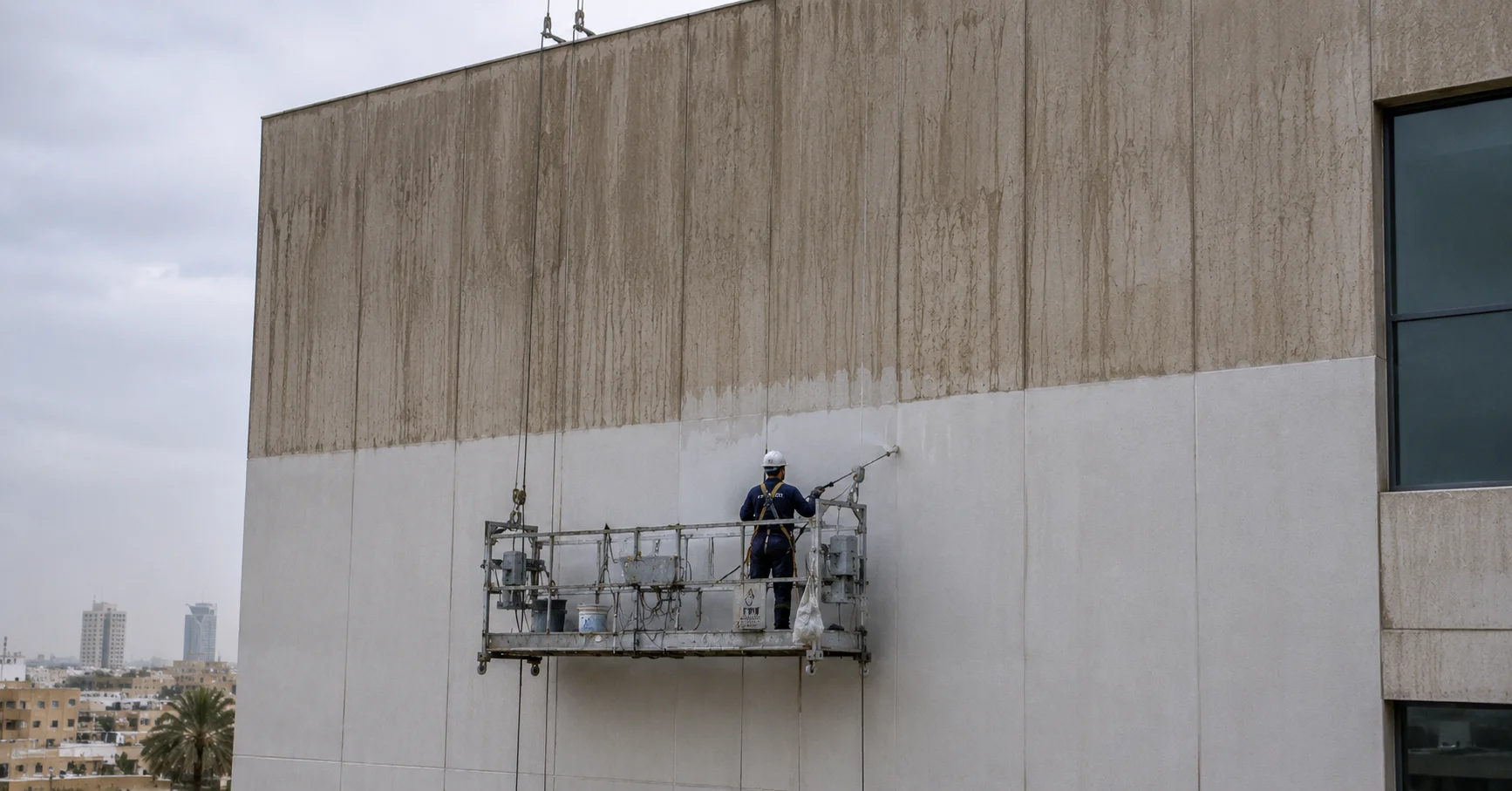
Reaches places lifts struggle to, needs no scaffolding, and does not require closing the building. On tall buildings it is faster and less costly than erecting and dismantling scaffolding.
Suits: tall buildings, ground below that cannot take a lift, and work that must proceed without disrupting the building.
Vehicle-mounted lift
Quick to set up, reaches the full facade height on mid-rise buildings, and leaves nothing attached to the structure.
Suits: sites with room to position and deploy, and work that must finish inside a narrow window.
Scaffolding
Fixed and stable, allowing precise, sustained work across a defined area.
Suits: tight frontages with no room for a lift, or work needing steady positioning in one zone.
Suspended cradles
Suit tall buildings already equipped for them, giving methodical coverage of a large elevation.
What should not decide it
Price alone. The cheapest method on paper may be the slowest in execution, or the wrong one for your site.
What was used next door. The neighbouring building has different space in front of it and different movement around it.
Contractor preference. If a contractor names a method before asking about the space in front of your building and the movement around it, they are describing what they own rather than what suits you.
Securing the area is part of the method, not an addition to it
Whichever method is used, securing the area beneath the work is not optional. Pedestrian movement below the working zone is kept clear throughout, and entrances and parking are secured before work starts.
What happens at survey
A survey is not a formality before pricing. It is where the entire technical decision gets made.
What we look at:
The elevation itself. The surface type or types, their condition, the building height, and any projecting elements such as canopies and signage that need different access from a flat face.
The ground in front of the building. Will it take a lift? Is there room to deploy? Will the entrance or parking be affected? Those are questions answered by standing on the site, not by looking at a photograph.
Movement around the site. Are there pedestrians or customers below the working zone? Does the building have peak hours that must be avoided?
The timing available. Some sites allow daytime work; others only before or after operating hours.
The method follows from those four, and the price follows from the method — in that order, not the reverse.
Why we will not name a method from a photograph
A photograph tells us the surface type and the approximate height, which is useful for starting the conversation. What it does not show is what actually decides the method: the width of the street, whether the ground will take equipment, the footfall around it, and any access restrictions.
So we give an initial view from a photograph and confirm it at survey before any commitment. Site inspection and quotation are free, and that is deliberate: the right decision needs someone to see the site, and seeing it should not cost you anything.
Choosing the method for your building
We determine the method at survey, not before it. Send us a photo of the facade, the approximate building height, and a note on the space in front of it, and we will explain which method suits and why before any commitment. Site inspection and quotation are free.